A bakery box has one job that a shipping carton never has: it is in direct, sustained contact with food that a customer is about to eat. That single fact pulls custom bakery packaging into a set of food-safety expectations that many first-time buyers do not see coming, and the ground under those expectations shifted recently when the grease barrier the whole industry relied on was pulled from the U.S. market. If you are ordering printed boxes for a bakery, a cafe or a dessert shop, here is what “food safe” actually requires in 2026 and how to specify a box that holds up to a buttery croissant without breaking any rules.
What “food safe” actually means for a printed box
Food safe is not a marketing adjective; it is a materials requirement. Any surface that touches food has to be made from materials cleared for food contact, which in the United States means the paperboard, the coatings and the adhesives all have to be food-grade rather than generic industrial stock. The most common practical mistake is with ink. Printing inks are not food-contact substances, so the design should live on the outside of the box, and boxes that carry interior printing or that will hold unwrapped, greasy items should use food-safe inks and a barrier between the print and the product. When a supplier calls a box “FDA-compliant,” they are asserting that the substrate and its coatings meet food-contact rules; it is fair to ask them to confirm that in writing, especially for boxes that hold unwrapped product.
The PFAS phase-out and why your grease barrier changed
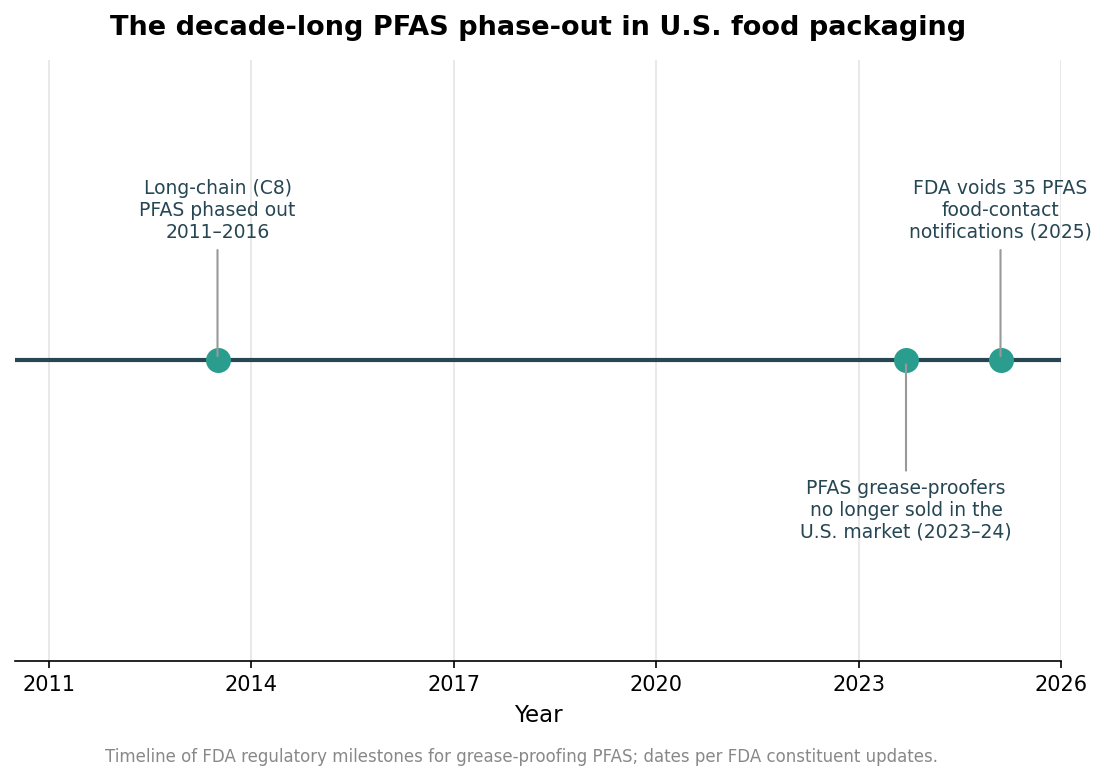
For decades the cheapest way to make paper resist grease was to treat it with PFAS, the “forever chemicals” that also happen to repel oil beautifully. That era is over. The FDA ran a phased withdrawal that stretched across more than a decade: long-chain C8 compounds were phased out between 2011 and 2016, the shorter-chain 6:2 FTOH chemistry was withdrawn through the early 2020s, and in February 2024 the agency announced that grease-proofing agents containing PFAS were no longer being sold into the U.S. market for use on paper food packaging. In January 2025 the FDA formalized this by ruling that 35 food-contact notifications tied to those substances were no longer effective. A number of states have gone further with their own PFAS-in-packaging bans, so the direction of travel is unambiguous.
For a bakery ordering boxes, the takeaway is simple: the grease resistance in a compliant box now comes from PFAS-free technology rather than fluorochemicals. That means water-based dispersion coatings, clay or mineral coatings, or purpose-made greaseproof and glassine papers. These alternatives work, but they do not all perform identically, which is why you now have to specify the barrier you need rather than assuming every box repels oil.
Reading grease resistance: the kit test
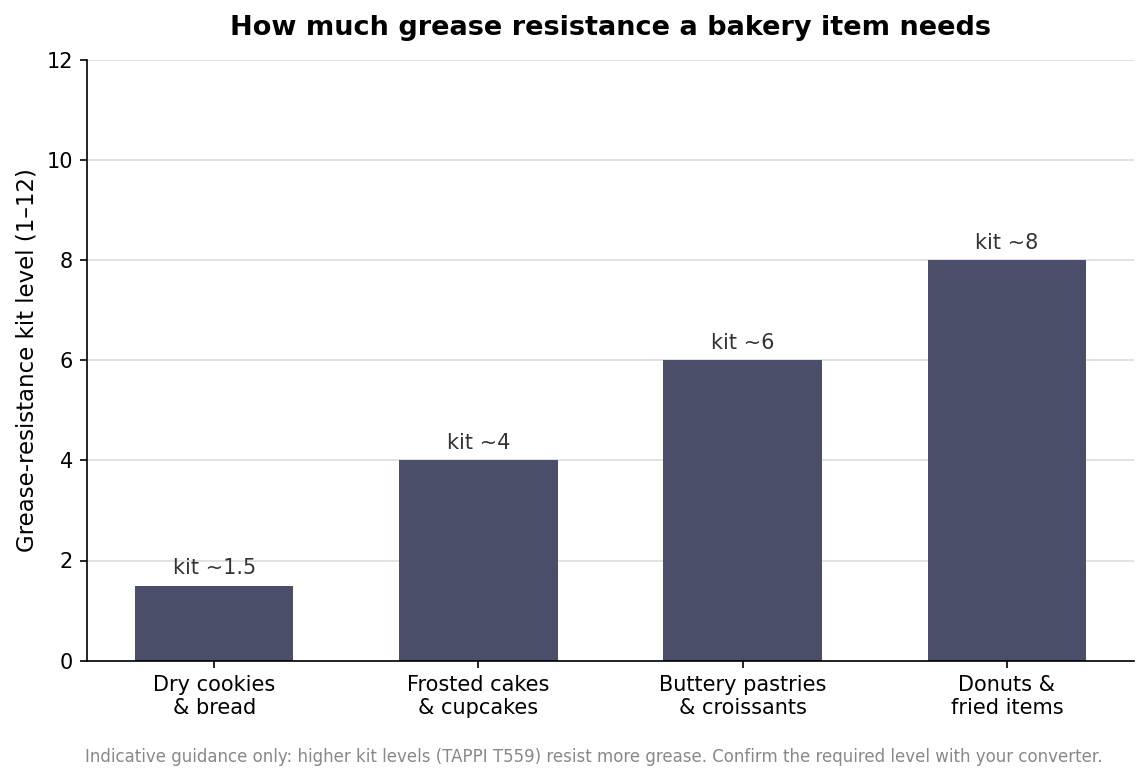
Grease resistance is measurable, and the standard measure is the kit test, defined in TAPPI method T559. It rates a paper or paperboard on a scale from 1 to 12, where a higher number means the surface resists more aggressive oil and grease. The value of the scale is that it turns a vague promise into a spec you can hold a supplier to. A dry product like a loaf of bread, a bagel or a plain cookie puts almost no oil against the box and needs little or no barrier. Frosted cakes and cupcakes sit in the middle. Buttery, laminated pastries and croissants demand more, and genuinely greasy items such as donuts and anything fried sit at the top of the range. Rather than paying for the highest kit level on every box, match the level to what you actually sell, and ask your converter which kit rating their PFAS-free stock achieves.
Compostable and recyclable claims you can back up
Sustainability claims are the other area where bakeries get into trouble, usually by calling a box “compostable” when it is only technically recyclable, or vice versa. Certified compostable packaging in North America is verified by BPI against ASTM standards: D6400 for the underlying plastic or bioplastic components and D6868 for coated paper and board. Those standards require that the material disintegrate, biodegrade into carbon dioxide, water and biomass, and leave no toxic residue behind. The important caveat for customers is that this happens under industrial composting conditions, typically 55 to 60 degrees Celsius, with certified items generally breaking down within 90 to 180 days. Home compost piles rarely reach those conditions, so a box that is genuinely compostable in a commercial facility may not break down in a backyard bin. If you print “compostable” on a box, be precise about which kind, because a plain uncoated kraft box and a poly-lined window box have very different end-of-life stories.
Specifying a compliant box: board, coatings, and printing
Put the requirements together and a clean specification falls out. Most bakery boxes are made from food-grade solid bleached sulfate or kraft paperboard, commonly in the range of roughly 250 to 350 grams per square meter, or about 14 to 18 point caliper; treat those as indicative starting points and let the box size and weight of the product dictate the final choice. Specify a PFAS-free grease barrier at a kit level suited to your product, keep printing and inks on the exterior or behind a food-safe barrier, and decide your end-of-life story, recyclable or certified compostable, before you approve artwork rather than after. If your box has a clear window, confirm the film is food-safe and understand that a plastic window usually changes how the box can be recycled or composted. A short conversation with your supplier covering food-contact compliance, kit level and disposal claims will catch nearly every problem before it reaches a customer’s hands, and it turns a box from a liability into part of the brand.
Leave a Reply