Custom printed bakery boxes are the better choice for styles you sell every day and boxes customers carry to gifts and events, while plain stock boxes with a logo sticker suit test products and changing menus. Customized Bakery Boxes prints from a minimum of 12, so this guide shows where each option wins and how to switch.
- Printed bakery boxes carry branding on the lid, front and sides; stickers cover one small spot.
- Stickers suit test flavors, rebrands in progress and back-of-house boxes.
- Customized Bakery Boxes prints from a minimum of 12 boxes.
- Free mockup within 24 hours, unlimited free revisions, pay nothing until you approve.
- Standard turnaround is about 2 weeks, with faster turnaround via express shipping.
Should my bakery use custom printed boxes or plain boxes with stickers?
Most bakeries should move to custom printed bakery boxes once they sell boxed orders every day, and stay with plain stock boxes plus a logo sticker while they are still testing products, sizes or a brand name. Printed boxes win on look, speed at the counter and consistency. Stickers win on flexibility when you are not sure yet what you will sell next month.
The decision is less about taste and more about volume and routine. A sticker has to be peeled, lined up and pressed onto every box by someone on your team, often during the morning rush. A printed box arrives with the logo already on the lid, so staff simply fold, fill and close. With a minimum of 12 boxes per order at Customized Bakery Boxes, the jump to printing is smaller than many owners expect, which means you can print one style that sells constantly and keep stickers for the rest.
This guide compares the two approaches side by side, then shows how to switch without wasting the stock boxes you already own.
How do custom printed bakery boxes compare with stickered stock boxes?
Custom printed bakery boxes and stickered stock boxes solve the same problem, putting your name on the package, but they behave very differently in a busy shop. The table below lines them up on the points bakery owners ask about most.
| Factor | Custom printed bakery boxes | Stock boxes with stickers |
|---|---|---|
| Branding area | Lid, front panel and sides can all carry artwork | One small label, usually on the lid |
| Look on the counter | Finished and consistent from box to box | Varies with how carefully each sticker is placed |
| Labor per box | Fold, fill, close | Fold, fill, close, then peel and apply a label |
| Changing the design | New artwork goes into the next order | Swap the sticker roll any time |
| Grease and moisture | Ink is printed into the board itself | Labels can lift or smudge near butter and condensation |
| Best for | Proven sellers and gift packaging | New launches, test flavors, one-off events |
The pattern is clear: printing earns its place on the boxes you use most, while stickers remain a useful tool for anything temporary.
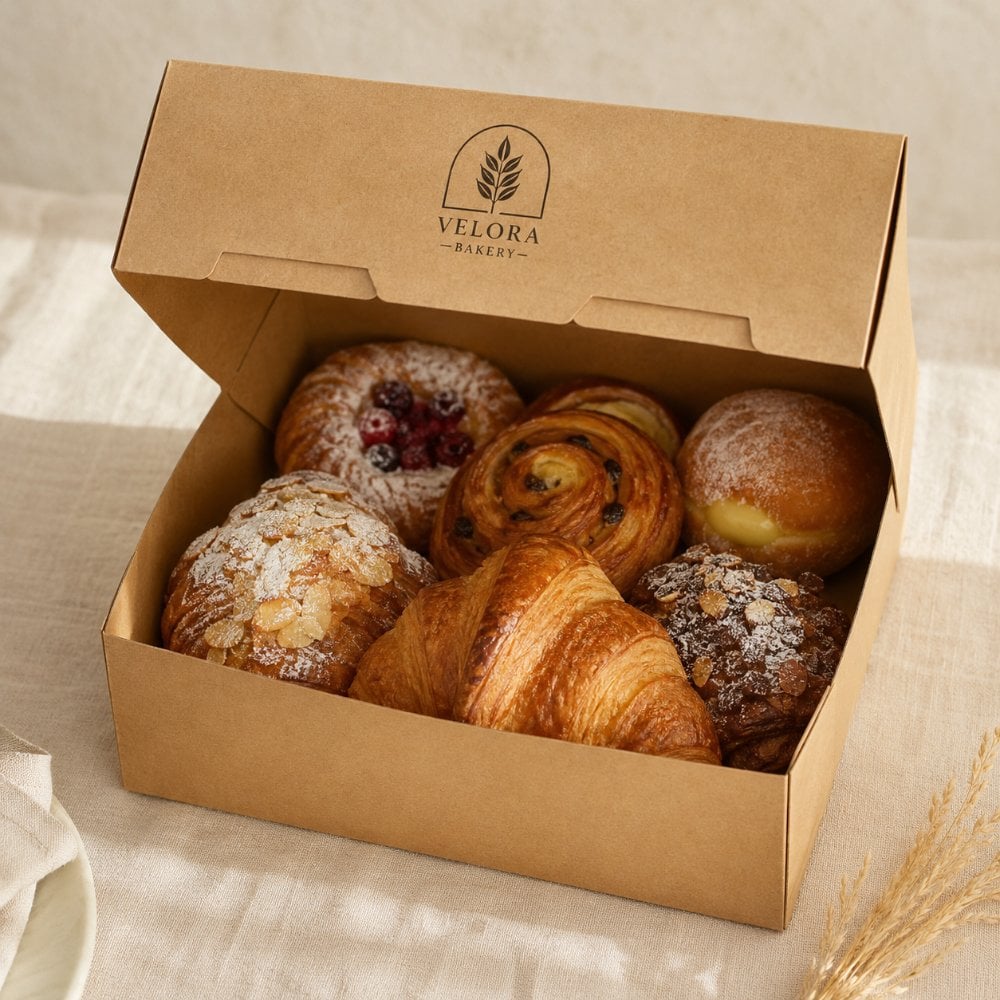
When are stickers on plain bakery boxes the smarter choice?
Stickers on plain bakery boxes are the smarter choice when your menu, sizes or brand are still moving. If you are launching a new pastry line, trying a seasonal pie for a few weekends or still deciding between two logos, a roll of labels lets you change course without being left with printed boxes you no longer need.
Stickers also make sense for jobs where the box itself is not seen much, such as wholesale trays delivered to a cafe kitchen or internal boxes used to move product between locations. In those cases the label is doing a practical job, identifying the bakery and the contents, rather than selling the product.
- Brand still in progress: a sticker avoids locking in a logo you may redesign.
- Short test runs: new flavors and limited items can ride on a generic label.
- Back-of-house boxes: wholesale and transfer boxes rarely need full print.
- Day-specific details: pickup names, dates and allergen notes are easier on a label.
Many bakeries keep a small sticker workflow even after they print, simply for those variable details.
When do custom printed bakery boxes pay off for a bakery?
Custom printed bakery boxes pay off when the same box leaves your shop over and over, especially for gifts, celebrations and catering, where the box becomes part of the product. A printed cake box or cupcake box carried into a party is seen by every guest, and a crooked sticker undercuts the care that went into the bake.
Printing also removes a recurring chore. Every label your team applies is a few seconds of labor and one more chance for an off-center logo. Across a busy weekend of pastry boxes, those seconds add up, and the printed version simply arrives ready to fold. Printed board also holds up better than a label near buttery croissants or chilled cakes, where condensation can loosen adhesive.
- Daily sellers: your standard pastry, cookie or donut box.
- Gift and event orders: wedding cakes, holiday cookie tins in box form, and corporate trays.
- Delivery and pickup: boxes that travel and get photographed for social media.
If one style accounts for most of your boxed sales, that is the first one to print.
Which bakery box styles should I print first?
Print the bakery box style you reach for most often, then work outward. For many shops that is a pastry and donut box or a standard bakery box, because those carry the everyday mixed orders. Cake shops usually start with the cake box, and cookie-focused bakeries start with the cookie box.
Specialty items deserve a second look. Macaron boxes and pie boxes are often bought as gifts, so a printed version adds visible value even if the volume is lower. A window box shows the product through the lid, which means the logo moves to the front flap or the band around the window, and a sticker there rarely looks intentional.
- List every box style you use and roughly which ones run out fastest.
- Mark the styles customers carry to gifts, parties and events.
- Print the style that is both high volume and highly visible.
- Keep stickers on low-volume or experimental styles until they prove themselves.
Customized Bakery Boxes can mock up several styles at once, so you can compare how one logo looks across your lineup before deciding.
Can I use custom printed boxes and stickers together?
Yes, and most bakeries end up using custom printed bakery boxes and stickers together. The printed box carries the permanent brand, your logo, colors, website and social handle, while a small label adds the details that change from order to order.
This hybrid approach keeps the box design clean and long-lasting. Instead of printing a seasonal flavor list onto the board, which would date the box, you print the evergreen brand and use a label for the flavor, the pickup name, a best-before note or an ingredient line. The label becomes a functional tag rather than the whole identity of the package.
- Printed on the box: logo, brand colors, website, social handle, a short tagline.
- On a label: flavor, customer name, order number, allergen notes, seasonal messages.
- Leave room: plan a clear spot on the lid or side so labels never cover the logo.
When you request a mockup, mention that you will add labels. The art team can keep a tidy blank zone so the finished box looks designed, not patched.
How do I switch from stickered boxes to custom printed bakery boxes?
Switching to custom printed bakery boxes is simplest when you plan the changeover around the stock boxes you already own. Use up existing plain boxes on low-volume items, and time your first printed order so it arrives as the stock of your main style runs low.
- Count what you have. Note how many plain boxes of each style remain on the shelf.
- Pick the first style to print. Choose your highest-volume, most visible box.
- Request a quote and mockup. Send your logo through the quote form; Customized Bakery Boxes returns a free mockup within 24 hours.
- Refine the design. Revisions are unlimited and free, and you pay nothing until you approve.
- Plan for production. Standard turnaround is about 2 weeks, with faster turnaround available through express shipping.
- Retire stickers gradually. Move remaining plain boxes to test items and back-of-house use.
The step-by-step how it works page covers the ordering flow in more detail, and the guide to how many bakery boxes to order helps size that first run.
What should I check before replacing stickers with printed bakery boxes?
Before replacing stickers with printed bakery boxes, check three things: that your logo file is final, that the box size fits your current products, and that the board stock suits what goes inside. Printing commits a design to the box, so a few minutes of review prevents an order you would want to redo.
- Logo: confirm you are not planning a rebrand soon, and send a vector file if you have one.
- Fit: measure your best-selling items in their current boxes and note any that feel cramped or loose.
- Stock: compare kraft, white and coated board using the board stock guide.
- Grease: for buttery or glazed items, read up on grease resistance.
- Window or solid: decide whether customers should see the product, using the window vs solid comparison.
Market and pop-up sellers face their own trade-offs; the page on bakery boxes for farmers markets and pop-up vendors covers that setting.
Frequently asked questions
Do custom printed bakery boxes look more professional than stickered boxes?
Custom printed bakery boxes usually look more professional because the logo is part of the board, perfectly placed on every box. Stickers can look neat when applied with care, but they drift off-center during busy shifts and sometimes lift at the edges. For gifts, weddings and catering, where customers notice presentation, printed boxes give a finished look that a label struggles to match.
Can I order printed bakery boxes in a small quantity to test the switch from stickers?
Printed bakery boxes start at a minimum of 12 at Customized Bakery Boxes, so you can test one style before committing your whole lineup. A small first run shows how the logo looks on the counter, how customers react and how much label time your staff saves. Once the test box proves itself, reorder it and add the next style.
Will logo stickers stay on bakery boxes holding buttery pastries?
Logo stickers on bakery boxes can loosen when butter, glaze or condensation reaches the adhesive, especially on boxes holding warm croissants or chilled cakes. Placing labels away from the base and on dry lids helps. Printed bakery boxes avoid the problem because the ink sits in the board, so there is no label edge to lift.
Is it faster to pack orders in printed bakery boxes than in stickered boxes?
Packing in printed bakery boxes is faster because the branding step disappears. Staff fold, fill and close without stopping to peel and place a sticker. On a single order the difference is small, but across a weekend rush of pastry and cookie boxes those saved seconds add up and free hands for the line.
Which bakery box style is best to print first when moving away from stickers?
The best bakery box style to print first is the one you use most and customers see most, often a pastry and donut box, standard bakery box or cake box. Customized Bakery Boxes can mock up several styles together within 24 hours, which makes it easy to compare your logo across the lineup before choosing.
Can printed bakery boxes still carry a flavor or name label?
Printed bakery boxes work well with a small flavor or name label. Print the permanent brand on the box, then use a label for details that change, such as the flavor, pickup name or allergen notes. Ask for a blank zone on your mockup so the label never covers the printed logo.
What should I do with plain stock boxes after switching to printed bakery boxes?
Plain stock boxes do not need to go to waste after you switch to printed bakery boxes. Use them for test flavors, wholesale deliveries, staff orders or back-of-house transfers where branding matters less. Time your first printed order so it lands as your main plain box style runs low, and the changeover stays smooth.
Should a new bakery start with stickers or printed bakery boxes?
A new bakery often starts with stickers on plain bakery boxes while the menu, sizes and logo settle. Once a box style sells steadily and the brand feels final, printing that style makes sense. With a 12-box minimum at Customized Bakery Boxes, the step from stickers to print can happen earlier than many new owners assume.
Can I print my website and social handle on bakery boxes instead of using a second sticker?
Bakery boxes can carry your website and social handle printed on a side panel or front flap, which removes the need for a second sticker. Side panels on cake and standard boxes have room for both. The free mockup shows exactly where each line sits, with unlimited revisions until the layout feels right.
How long does it take to replace stickered boxes with custom printed bakery boxes?
Replacing stickered boxes with custom printed bakery boxes follows a simple timeline: a free mockup within 24 hours, revisions until you approve, then standard turnaround of about 2 weeks. Customized Bakery Boxes offers faster turnaround with express shipping, so order before your plain box stock runs out to avoid a gap.
Do printed bakery boxes cost more than buying plain boxes and stickers?
Printed bakery boxes and stickered plain boxes are priced differently, and the comparison depends on box style, size, board stock, print coverage and quantity. Label time adds a hidden labor cost to stickers. Customized Bakery Boxes gives an exact figure through the quote form, and you pay nothing until you approve the design.
Get a free mockup for your bakery boxes
Send your logo or idea and the quantity you have in mind. Customized Bakery Boxes returns a free mockup within 24 hours, you approve the design before anything is produced, and standard turnaround is about two weeks with faster options available. Get a custom quote.